
ker Casillas didn't just make saves;he redefined what a save could mean in the biggest moments. That reflex stop against Arjen Robben in the 2010 World Cup final—foot outstretched, body twisting—wasn't just athletic brilliance. It was the culmination of a goalkeeping philosophy built on anticipation and nerve. Casillas saves aren't about spectacle;they're about consequence. Every deflection。
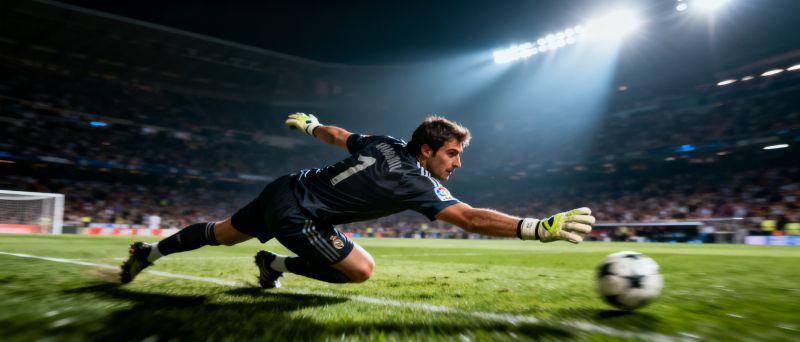
every parry, every smothering of the ball carries the weight of a match, a tournament, a legacy.Watch enough footage of Casillas and you notice something: his best saves rarely look desperate. He doesn't flail. He doesn't dive late. The positioning is so precise that the save itself often seems almost mundane—a simple block。a comfortable catch. That's the illusion. Behind every one of those Casillas saves lies a mental algorithm: reading the striker's hips, the angle of the run, the likely trajectory. Against Sevilla in 2010, he made a double save that looked impossible in real time, but slowed down, you see him shifting his weight before the first shot even left the boot. That's not luck. That's preparation meeting instinct.Penalties expose a goalkeeper's soul. Casillas saves in shootouts—the 2008 Euro quarter-final against Italy, the 2012 semi-final against Portugal—weren't about guessing. He waited. He held his ground an extra fraction of a second, forcing takers to commit first. Daniele De Rossi still talks about that night in Vienna;he says Casillas's presence made the goal seem smaller. I've rewatched those saves dozens of times. What strikes me isn't the dive—it's the stillness before it. The calm. That's the part young keepers miss when they try to mimic him.
There's a physical dimension too that gets overlooked. Casillas saves often came from a low center of gravity, a compact stance that allowed explosive lateral movement. He wasn't the tallest keeper, and he knew it. So he trained his legs relentlessly—short。sharp steps, never overcommitting. The save against Perotti in 2009, a low drive that seemed destined for the corner, showed that footwork. No dramatic leap. Just a rapid shuffle and a strong hand. It looked easy. It wasn't. The best Casillas saves always carry that deceptive quality: the harder they are。
the simpler they appear.Legacy in goalkeeping is usually measured in trophies and clean sheets. Fine. Casillas has those. But the real measure is imitation. You see young keepers now holding their ground on penalties, staying big instead of diving early. That's the Casillas influence. He made the unglamorous parts of shot-stopping—positioning。patience, footwork—cool. And when you break down any list of his greatest saves, you find the same thread: not athleticism, not luck, but a stubborn refusal to be beaten by the obvious. That's the lesson. That's what a Casillas save really teaches.